Where diners actually find you
People rarely find a café by typing its name. They search "breakfast near me", "brunch Lüneburg" or "nice restaurant old town", and they decide from what comes back: the Google local pack, Google Maps, a few food directories, and increasingly an AI answer. For gastronomy, being visible in those places matters more than for almost any other kind of business, because the decision is immediate and local. The good news: a handful of gastro-specific moves cover most of it.
Put your menu where machines can read it
This is the single most common gastro mistake: the menu lives only as a PDF or a photo, or on a third-party page, but not as real text on your own site. Google and AI systems cannot read a picture of a menu the way they read text. If someone asks "where can I get a vegan breakfast in Lüneburg", the AI can only recommend you if the words "vegan" and "breakfast" are readable on your page. Put your menu on its own page as structured text, with dish names, short descriptions and prices, not as an embedded image or a download-only PDF.
The right schema for gastronomy
Use a specific food type, not the generic LocalBusiness, and fill the gastro fields.
| Field | Why it matters |
|---|---|
| Restaurant / CafeOrCoffeeShop | The specific type, so Google places you as gastronomy |
| hasMenu | Links your crawlable menu page; feeds rich results and AI |
| servesCuisine | What you serve, coffee, cake, breakfast, regional |
| priceRange | Sets expectations, for example € or €€ |
| openingHoursSpecification | Structured hours, including special days |
| acceptsReservations | A useful signal for restaurants |
More on this is in our structured data guide; for gastro the one to get right first is a crawlable menu wired up with hasMenu.
Reviews decide the local pack
For restaurants and cafés, reviews are the loudest signal of all. Number, recency and score decide who makes the top three in the local pack, and they are exactly what a hungry searcher scans first. Ask happy guests for a review, make it easy, reply to all of them, and keep it honest, no bought reviews. The habit matters more than any one-off push. The full method is in our reviews guide.
The gastro directories that count
Beyond Google, a few German food platforms carry weight, and consistent listings on them strengthen your local signals. The ones worth keeping accurate:
- Google Business Profile first, always, with menu link, photos and hours.
- Speisekarte.de and speisekarte.menu for menu visibility.
- TripAdvisor and TheFork for restaurants, especially with tourist traffic.
- GoLocal and Das Örtliche for general local presence.
Keep your name, address and phone identical across all of them; contradictions weaken your ranking.
Profile details that turn a view into a visit
Once the basics are in place, the details on your Google profile do the converting. Add real photos of the food, the room and the front of the house, and refresh them now and then; gastro profiles with strong photos get noticeably more clicks and direction requests. Fill in the attributes that match a diner’s filter: outdoor seating, vegan or vegetarian options, wheelchair access, free wifi, dog friendly. Each one can put you in a more specific search. And use Google Posts for what is happening this week, a seasonal menu, a brunch special, an event, so your profile looks alive rather than abandoned. None of this is ranking magic; it is the difference between someone seeing you and someone choosing you.
AI answers name restaurants too
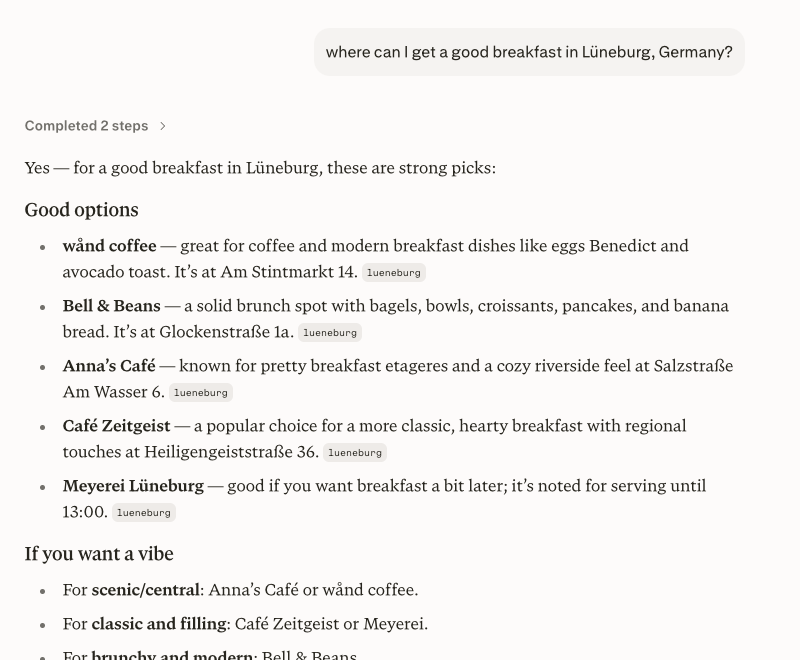
Ask Perplexity or ChatGPT "where to have breakfast in Lüneburg" and you get a named shortlist, like the one above. Whether your café is on it comes down to the same things: a readable menu, a complete profile, real reviews and clear text about what you offer. Do the gastro groundwork and you get named in AI answers as well as in the map.
Frequently asked questions
My menu changes often, do I still put it on the site?
Yes. Keep a simple text menu page and update the items; even a stable list of your staples plus daily specials beats a PDF. What matters is that the words are readable.
Is a reservation tool worth it?
If you take reservations, yes, and mark acceptsReservations in your schema. It is a real convenience signal for both diners and Google.
Do photos matter for a café?
A lot. Food and interior photos on your profile drive clicks and direction requests, and they reassure diners before they arrive.
We are a small café, is all this worth it?
The basics are: a crawlable menu, a complete Google profile and steady reviews. That covers most of the visibility for a fraction of the effort a bigger campaign would take.